CNC Machining Industry Trends: Precision, Automation and Smart Manufacturing Are Reshaping Modern Production
The global manufacturing landscape is changing quickly. Customers no longer look only for basic machining capacity. They need faster lead times, tighter tolerances, flexible production, stable quality, and suppliers who can support complex parts from prototype to low-volume and batch production. Because of this shift, CNC Machining Industry Trends are now closely connected with automation, digital manufacturing, AI, advanced inspection, reshoring, and high-precision engineering.
For manufacturers, machine shops, OEM buyers, and product development teams, understanding these trends is essential. The future of precision CNC machining is not only about cutting metal faster. It is about building a smarter, more reliable, and more data-driven manufacturing process.
1. Precision CNC Machining Demand Continues to Grow
One of the strongest CNC machining industry trends is the rising demand for high-precision components. Industries such as aerospace, medical devices, electric vehicles, robotics, industrial automation, electronics, and energy equipment all require parts with tighter tolerances, better surface finish, and more consistent quality.
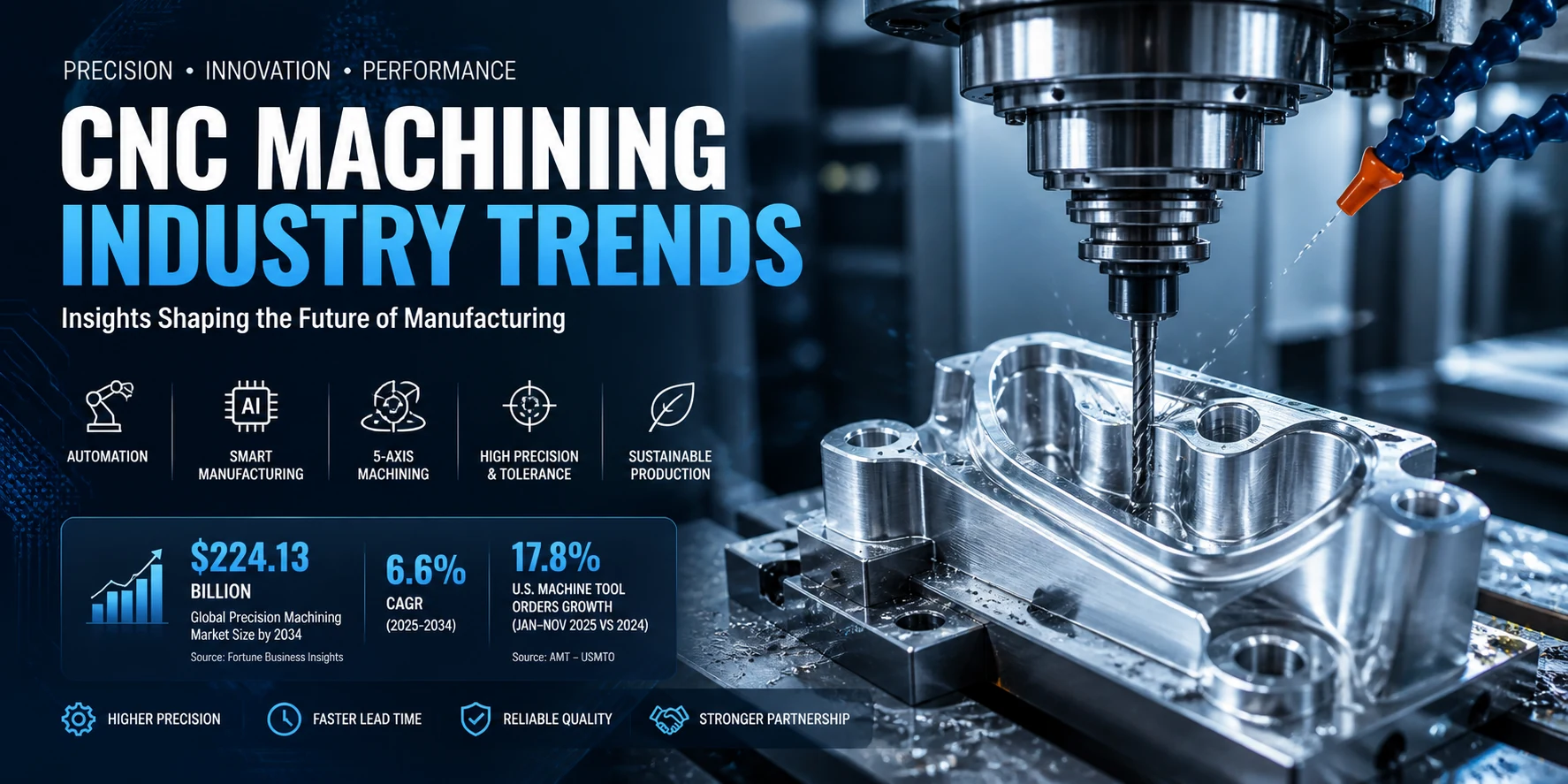
According to Fortune Business Insights, the global precision machining market was valued at USD 126.99 billion in 2025 and is projected to grow to USD 224.13 billion by 2034, with a CAGR of 6.6%. This growth reflects increasing demand for accurate, complex, and high-value machined components across advanced industries.
For CNC suppliers, this means customers are paying more attention to:
- tight tolerance machining
- material traceability
- stable batch production
- CMM inspection reports
- consistent surface finishing
- engineering support before production
In other words, custom CNC machining is moving from simple order processing to full manufacturing support.
2. CNC Machining Automation Is Becoming a Competitive Advantage
Automation is no longer only for large factories. More small and medium-sized CNC shops are adopting robotic loading, pallet systems, automated tool management, in-process measurement, and lights-out production strategies. These technologies help reduce labor pressure, improve spindle utilization, and increase production consistency.
The International Federation of Robotics reported that 542,000 industrial robots were installed globally in 2024, marking the fourth consecutive year that annual installations exceeded 500,000 units. Asia accounted for 74% of new robot deployments, showing how fast factory automation is spreading across manufacturing regions.
For CNC machining services, automation can improve:
- machine uptime
- repeatability
- production speed
- cost control
- quality stability
- overnight production capacity
This is especially important for low volume CNC machining and repeat production orders, where customers want both flexibility and reliable lead times.
3. AI in CNC Machining Is Moving From Concept to Practical Use
Another important trend is the growing role of AI in CNC machining. AI can support tool wear prediction, cutting parameter optimization, production planning, machine monitoring, quality analysis, and predictive maintenance. Instead of relying only on operator experience, manufacturers can use real-time machine data to make better production decisions.
Deloitte’s 2026 Manufacturing Industry Outlook notes that smart manufacturing investment is expected to continue growing. A Deloitte survey of 600 manufacturing executives found that 80% plan to invest 20% or more of their improvement budgets in smart manufacturing initiatives, focusing on foundational technologies such as automation hardware, sensors, data analytics, and cloud platforms.
For CNC factories, this trend means future competitiveness will depend on how well they connect:
- CNC machines
- ERP systems
- CAD/CAM software
- inspection equipment
- production data
- customer quality requirements
The shops that can combine skilled operators with digital tools will be better positioned to deliver reliable precision CNC machining services.
4. 5-Axis CNC Machining Supports More Complex Parts
As product designs become more compact and complex, 5-axis CNC machining is becoming increasingly important. Compared with traditional 3-axis machining, 5-axis technology allows manufacturers to machine complex geometries with fewer setups, better accuracy, and improved surface quality.
This is especially valuable for:
- aerospace structural components
- medical device parts
- EV motor housings
- robotics components
- precision aluminum parts
- stainless steel and titanium parts
- complex mold and fixture components
For buyers, 5-axis capability can reduce production risk because fewer setups often mean fewer alignment errors. For manufacturers, it creates opportunities to serve higher-value industries such as aerospace CNC machining, medical device machining, and EV parts machining.
5. Reshoring and Nearshoring Are Changing CNC Supply Chains
Supply chain resilience has become a major consideration for OEMs and purchasing managers. Many companies are reviewing whether they should move some production closer to end markets to reduce risk, shorten lead times, and improve supplier communication.
NIST notes that reshoring is being driven by a stronger focus on supply chain resilience, because bringing manufacturing closer to home can reduce exposure to transportation delays, geopolitical disruptions, and long-distance sourcing risks.
Deloitte has also highlighted that reshoring and nearshoring may reshape supply chain flows, with surveyed transportation and manufacturing executives expecting 20% or more of freight originating from Asia to shift to the Americas by 2025.
For CNC machining companies, this creates opportunities in:
- local prototype machining
- emergency replacement parts
- short-run production
- supplier diversification
- domestic machining support
- engineering-to-production services
Buyers may not move all production locally, but they are increasingly looking for backup suppliers and regional CNC machining partners.
6. Machine Tool Investment Shows Confidence in Manufacturing Capacity
Capital equipment investment is another signal behind CNC machining industry trends. When manufacturers invest in new machine tools, it usually indicates demand for higher productivity, automation, accuracy, and capacity expansion.
AMT’s United States Manufacturing Technology Orders report showed that U.S. metalworking machinery orders reached USD 4.92 billion through November 2025, a 17.8% increase over the first 11 months of 2024. AMT describes these orders as a leading indicator because manufacturers invest in capital metalworking equipment to increase capacity and improve productivity.
This trend suggests that CNC shops are not only replacing old equipment. Many are preparing for more demanding production requirements, including advanced materials, tighter tolerances, and automation-ready machining cells.
7. Quality Control and Tolerance Management Are Becoming More Important
As CNC parts become more complex, quality control must also become more advanced. Customers increasingly expect documentation, inspection records, and process consistency—not just finished parts.
For high-value CNC machining services, quality control may include:
- First Article Inspection
- CMM inspection
- dimensional reports
- surface roughness testing
- material certificates
- process control plans
- in-process measurement
- final visual inspection
This is especially important in tight tolerance machining, where small dimensional errors can affect assembly, performance, or safety. A strong CNC machining partner should not only machine the part, but also verify that the part meets engineering requirements before delivery.
8. Skilled Labor Remains a Major Challenge
Even with automation and AI, skilled people remain essential. CNC programming, fixture design, material selection, inspection, toolpath optimization, and problem-solving still require experienced engineers and technicians.
Deloitte’s 2025 Manufacturing Industry Outlook reported that nearly 60% of manufacturers in a National Association of Manufacturers survey cited the inability to attract and retain employees as their top challenge.
SME also described the manufacturing skills gap as a competitiveness issue, an economic resiliency issue, and even a national security concern when discussing its Workforce 2030 initiative.
For CNC machining companies, workforce development should be treated as a strategic investment. The most competitive suppliers will combine skilled machinists with modern CNC machines, CAM programming, automation, and digital quality systems.
9. What Buyers Should Look for in a CNC Machining Partner
As these CNC machining industry trends continue, buyers should evaluate CNC suppliers based on more than price. A strong machining partner should be able to support design, prototyping, production, inspection, and communication.
Key capabilities to look for include:
- experience in custom CNC machining
- ability to handle prototype and low-volume production
- 3-axis, 4-axis, and 5-axis machining capability
- engineering review before production
- material expertise in aluminum, stainless steel, brass, copper, plastics, and titanium
- tight tolerance machining experience
- quality inspection equipment
- fast quotation and clear communication
- stable delivery performance
- support for surface finishing and assembly
For OEMs and product developers, the right supplier can help reduce production risk, improve manufacturability, and shorten time to market.
Conclusion: CNC Machining Is Becoming Smarter, Faster and More Precision-Driven
The latest CNC Machining Industry Trends show a clear direction: the industry is moving toward higher precision, more automation, smarter data use, stronger quality control, and more resilient supply chains. Precision machining demand is growing, automation adoption is expanding, and AI-driven manufacturing tools are becoming more practical for modern CNC shops.
For buyers, this means choosing a CNC machining partner with the right combination of equipment, engineering knowledge, quality control, and production flexibility. For manufacturers, it means investing not only in machines, but also in people, data, inspection systems, and long-term process improvement.
In the years ahead, successful CNC machining companies will not simply produce parts. They will provide reliable manufacturing solutions for complex, high-value, and mission-critical components.
Data Sources Used
| Data / Insight | Source |
|---|---|
| Global precision machining market size and forecast | Fortune Business Insights |
| Global industrial robot installations in 2024 | International Federation of Robotics |
| Smart manufacturing investment outlook | Deloitte 2026 Manufacturing Industry Outlook |
| Reshoring and supply chain resilience | NIST |
| Freight shift from Asia to the Americas | Deloitte reshoring research |
| U.S. manufacturing technology orders | AMT / USMTO |
| Manufacturing labor shortage challenge | Deloitte 2025 Manufacturing Industry Outlook |
| Manufacturing skills gap | SME Workforce 2030 |